Fee collection is the process most likely to decide whether an online school survives its second year, and it is much harder than the equivalent job in a physical school for one structural reason: there is no front office. Nobody is standing at a desk when a parent walks past. Every payment has to be requested, received and reconciled at a distance, often across a border.
This is the operational guide to doing that — the decisions to make deliberately, in roughly the order they bite.
Decision 1: what you are billing for
Online schools tend to inherit a fee structure from a physical school and then discover it does not fit.
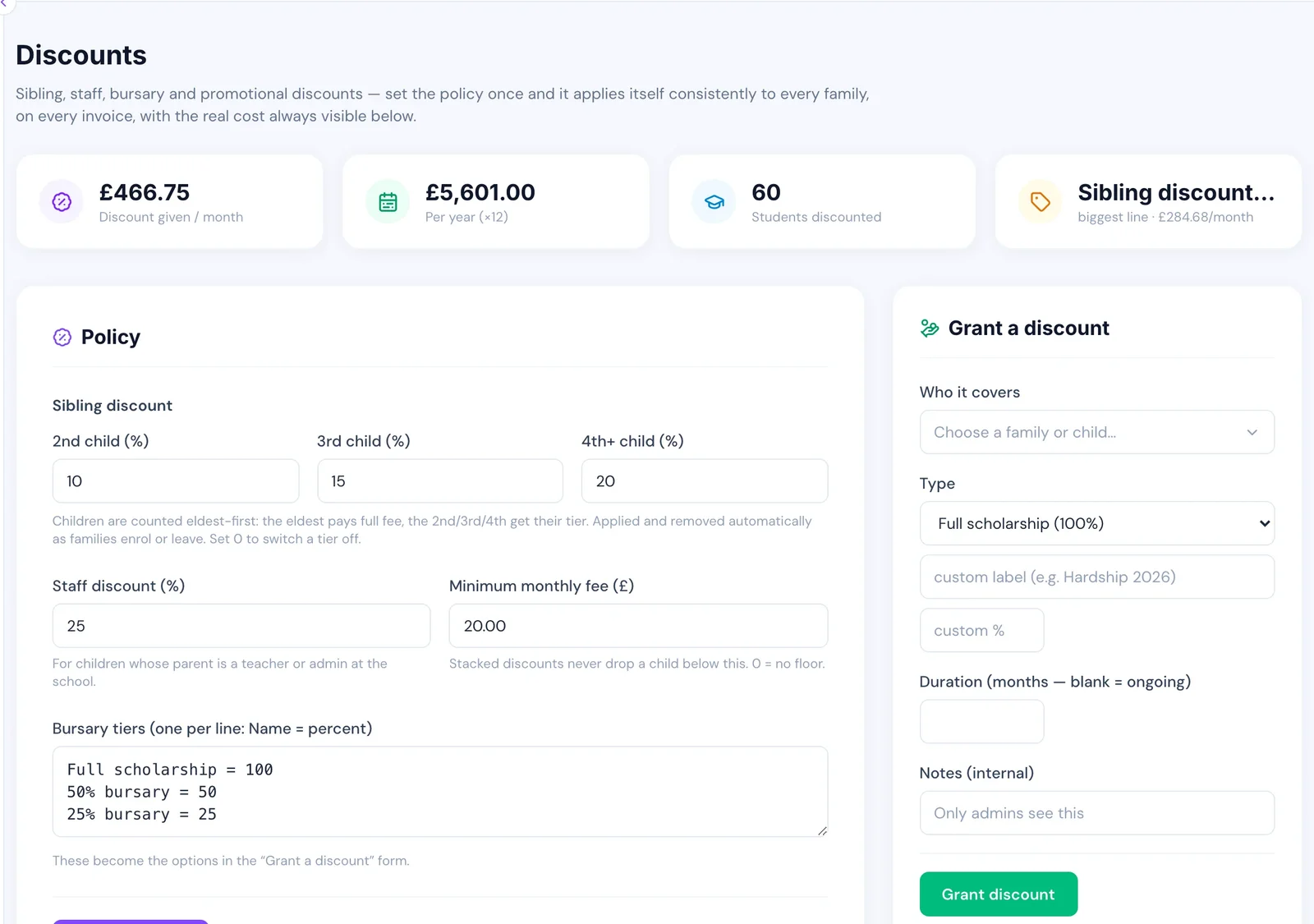
Per pupil or per family? Almost always per pupil, with a sibling discount applied to the second and subsequent child. The reason is unglamorous: children leave individually. A single family-level fee has to be recalculated by hand every time one child leaves or joins, and hand-recalculated fees are where errors live.
The pattern that causes least pain in practice is one billing arrangement per child, one payment method per family. Each child's place is independently priced, paused, and stopped; the parent still only enters their card once.
How often? Monthly is what most families expect and what smooths your cash flow. Termly reduces admin and matches the academic year but produces three large, painful invoices — and a large invoice is a large decision, which means it gets deferred. Weekly suits schools running short courses or supplementary Saturday provision.
There is no universally right answer, but there is a wrong one: letting different families run on different cycles because each was set up ad hoc. That is unmanageable at fifty pupils and impossible at two hundred.
Decision 2: card, bank transfer, or both
A lot of software silently assumes card payment. Plenty of real schools cannot use it — the fees are too high for their margins, their families do not use cards, or the school operates somewhere card acquiring is genuinely difficult.
Card / direct debit. The money arrives on time without anyone doing anything, which is the entire argument and it is a strong one. Costs a percentage. Requires a payment processor that will accept your school, which is not automatic for a young education business.
Bank transfer. Effectively free, familiar to families everywhere, and the norm in much of the world. The cost is human: somebody has to look at the bank statement, match each payment to a pupil, and record it. That job takes a couple of hours a month at fifty pupils and becomes a part-time role at three hundred.
Cash and everything else. Still real, particularly for supplementary and community schools. Needs recording the same way as everything else or it disappears.
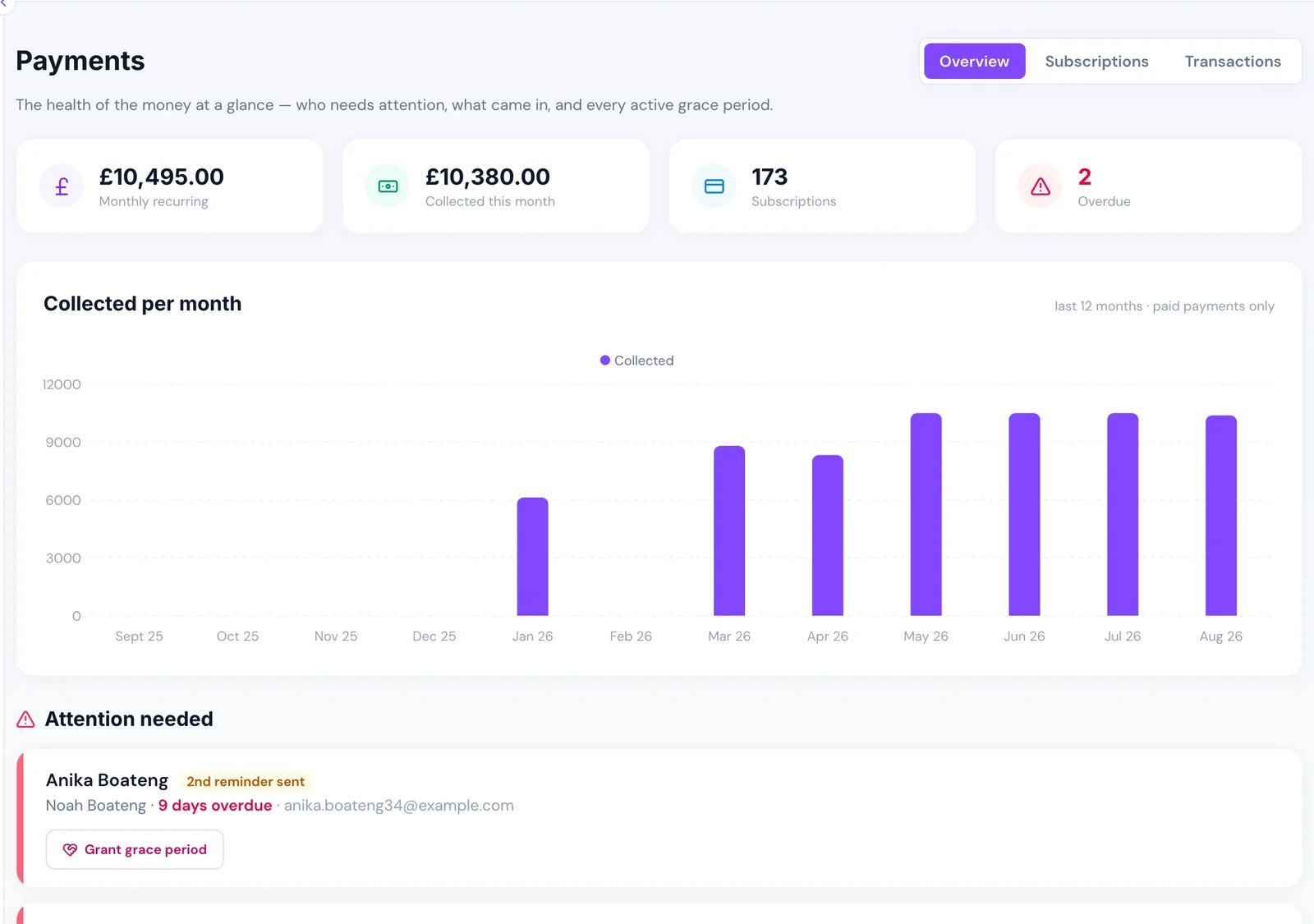
Treat the manual rails as first-class rather than as a workaround. A school collecting by bank transfer is not doing a worse version of card payment — it is doing the normal thing for its context, and it still needs invoices, receipts, reminders and a clear record of who is paid up to when. The concept that makes this manageable is "paid until": every pupil has a date their fees cover them to, however the money arrived.
Families abroad add their own failure modes — cards that decline for no visible reason, transfers that arrive short after intermediary fees, and due dates that mean different days in different places. Those are covered in taking school fees from families in another country.
One warning if you operate in more than one currency: watch for hard-coded limits. A validation rule capping a payment at 50,000 was written by someone thinking in pounds; the same number in a currency with a smaller unit is an ordinary monthly fee, and the school hits a wall it cannot explain. Every cap should be derived from the currency, not typed in.
Decision 3: does access depend on payment?
This is the decision schools most want to avoid making, and avoiding it is the expensive option.
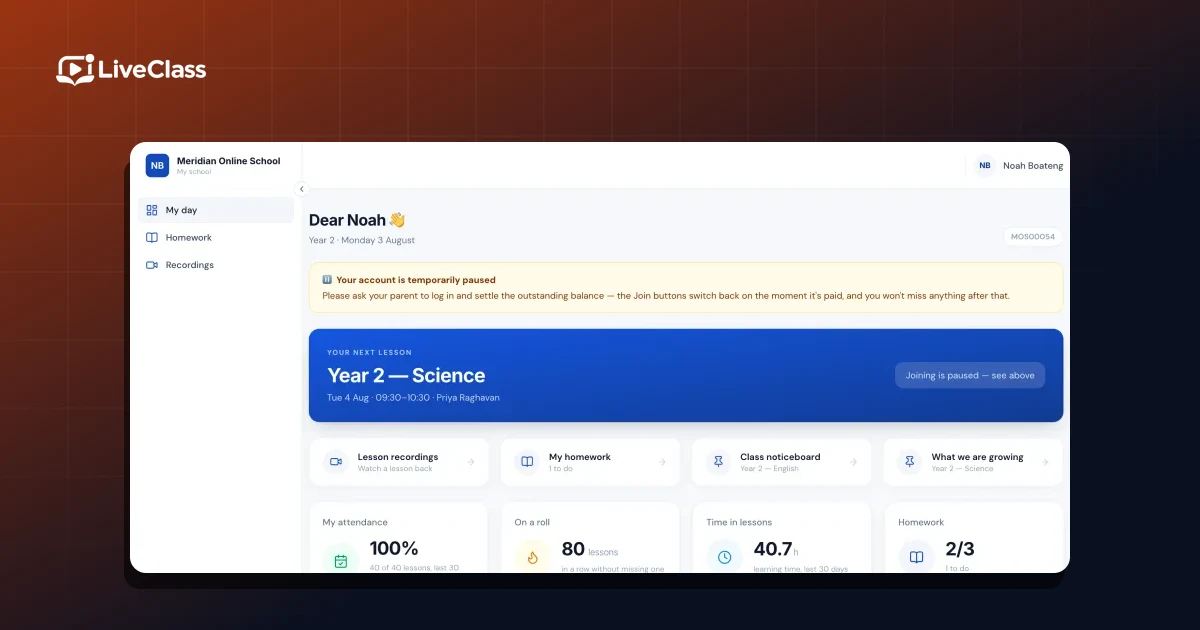
If access is linked to payment, a pupil whose fees lapse loses their lesson links until the account is settled. The system enforces the rule, so no member of staff has to. It is unambiguous, it is applied identically to everyone, and — provided the warnings before it happen are clear and early — most parents accept it as the deal.
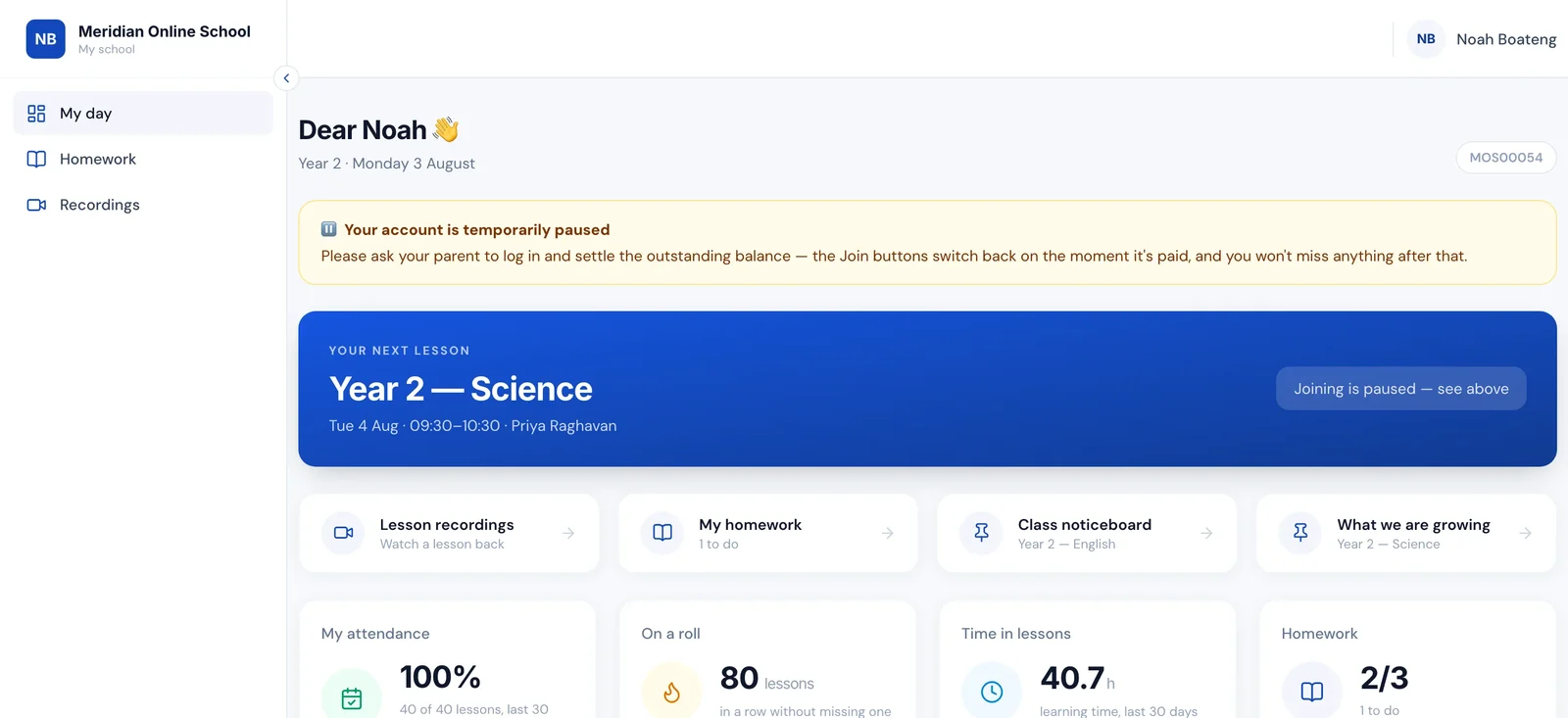
If access is not linked to payment, the school teaches on trust and chases separately. This is a perfectly defensible choice, particularly for community and faith schools where excluding a child over money is contrary to the entire point. But it only works if somebody is genuinely doing the chasing.
What does not work is the middle: a policy that says access depends on payment, and a practice of never enforcing it. Parents learn the real rule quickly, and the school ends up with both the harshness of the policy and none of the collection. The full case on each side, and the four rules if you do link them, is in should lesson access depend on payment?
Whichever you choose, the humane implementation is the same — warn well before the cliff. A reminder a few days before fees are due, framed as information rather than a threat, collects a surprising share of what would otherwise become arrears. Most late payment is not refusal; it is a parent who genuinely forgot.
Decision 4: what happens when someone does not pay
Chase on a fixed ladder, not on a feeling. A sequence that runs at zero, three, seven and fourteen days past due, and then stops, has two properties that matter: it is obviously automatic, so nobody feels singled out; and it ends, so the school does not train families to ignore it.
After the ladder ends, the case belongs to a human, and it is a conversation about circumstances rather than another copy of the same email. Some of those conversations end in a payment plan, some in a bursary, and some in a family leaving — all three are better outcomes than a reminder sent every week for a term.
The full sequence, including what to write, is in chasing unpaid school fees without falling out with parents.
Decision 5: leavers
When a family leaves, deregister rather than delete. Deleting a pupil to tidy the list destroys the attendance history, the reports and the payment record — exactly the things you need if there is later a dispute about what was paid for and what was delivered.
Cancel the billing, mark the pupil as left, keep the record. Retain it for as long as your data protection policy says and no longer.
The thing that actually goes wrong
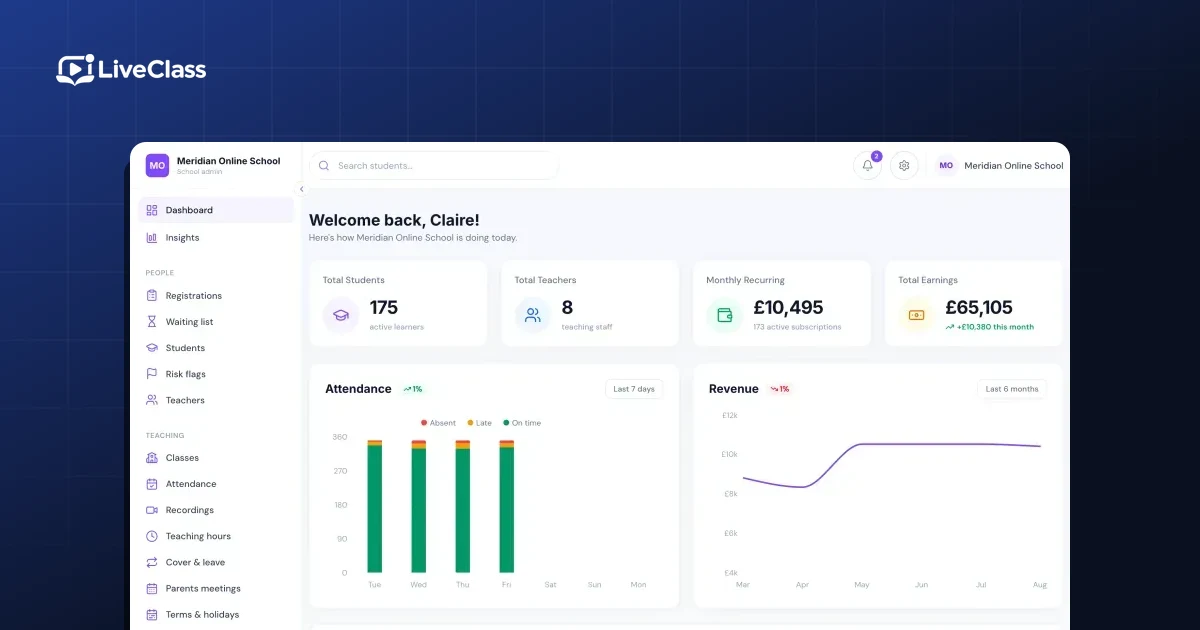
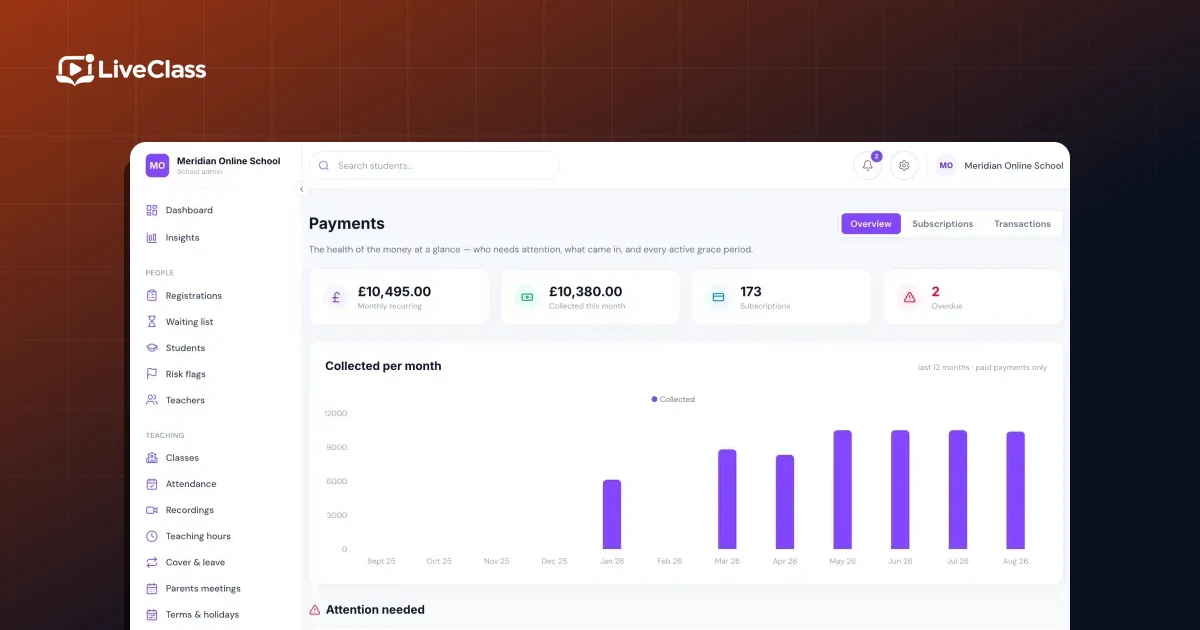
Almost every fee problem in an online school traces back to the same root: the school cannot answer, instantly, who is paid up to when.
If that answer lives in a spreadsheet updated from a bank statement once a month, it is out of date most of the time, so nobody trusts it, so nobody uses it, so chasing happens when someone remembers. Everything above — the cycle, the rails, the access rule, the ladder — depends on that one fact being current and visible.
Fix that first, even before you change anything else. A school that knows exactly who owes what collects most of it without doing anything else differently.