Running an online school is not running a school with the classrooms swapped for Zoom links. The teaching transfers more easily than anyone expects. The administration does not, and that is where online schools actually struggle: the register, the fees, the cover arrangements and the parent relationship all lose the building they used to depend on.
This guide covers the operational side — the six things that have to work every week, and the specific way each one tends to fail. It assumes you have already settled the regulatory question of whether your school needs to register with the DfE; everything below is what happens afterwards. It is written from building and running the system a school of several hundred pupils uses, so the failure modes below are ones we have watched happen rather than ones we imagine.
The building was doing more work than you think
In a physical school, a surprising amount of administration is done by the building itself, for free.
A child walks through the gate, so you know they attended. A parent comes to collect them, so you have a relationship with that parent whether you planned one or not. A teacher is off sick, so the head sees the gap in the corridor at 8:40 and finds cover. Fees are chased in person, awkwardly, and mostly get paid because the awkwardness is unavoidable.
Take the building away and every one of those becomes a task somebody has to consciously do. That is the whole job. Online schools that struggle are almost never struggling with teaching quality — they are struggling because six invisible processes became visible all at once, and nobody was hired to do them.
1. Enrolment: the pipeline that leaks
An enquiry arrives by email, WhatsApp, a form, or a message to somebody's personal Instagram. Someone replies. Someone else replies to a different one. Two weeks later nobody can say how many families are waiting to hear back.
This is the single most expensive failure on the list, because every leaked enquiry is a full year's fees. It is also the easiest to fix, and the fix is not software — it is deciding that enquiries live in exactly one place, and that every enquiry has a state: new, contacted, assessed, offered, enrolled, declined.
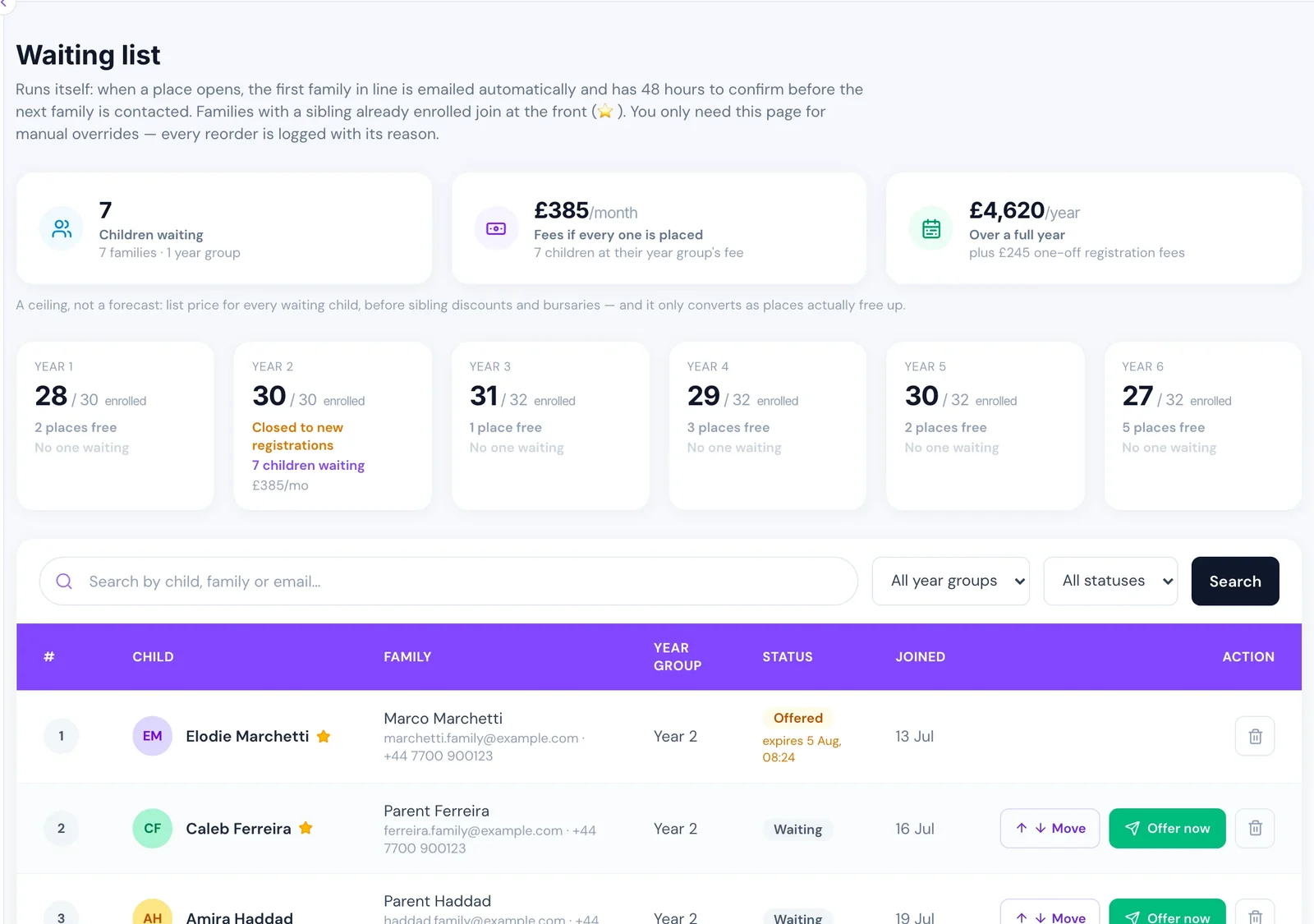
The specific thing online schools get wrong here is treating a full year group as a dead end. If Year 7 is full, the enquiry does not stop being valuable — it becomes a waiting list entry, and waiting lists convert extremely well because the family has already chosen you. A closed year group should still take names.
2. Fees: the part that decides whether the school survives
Physical schools chase fees badly and get away with it. Online schools cannot, for two reasons.
First, families are often in a different country from the school, so a bank transfer is not a five-minute job. Second, there is no doorstep. The parent who has not paid is not standing in front of you at pickup.
Two decisions matter more than the rest:
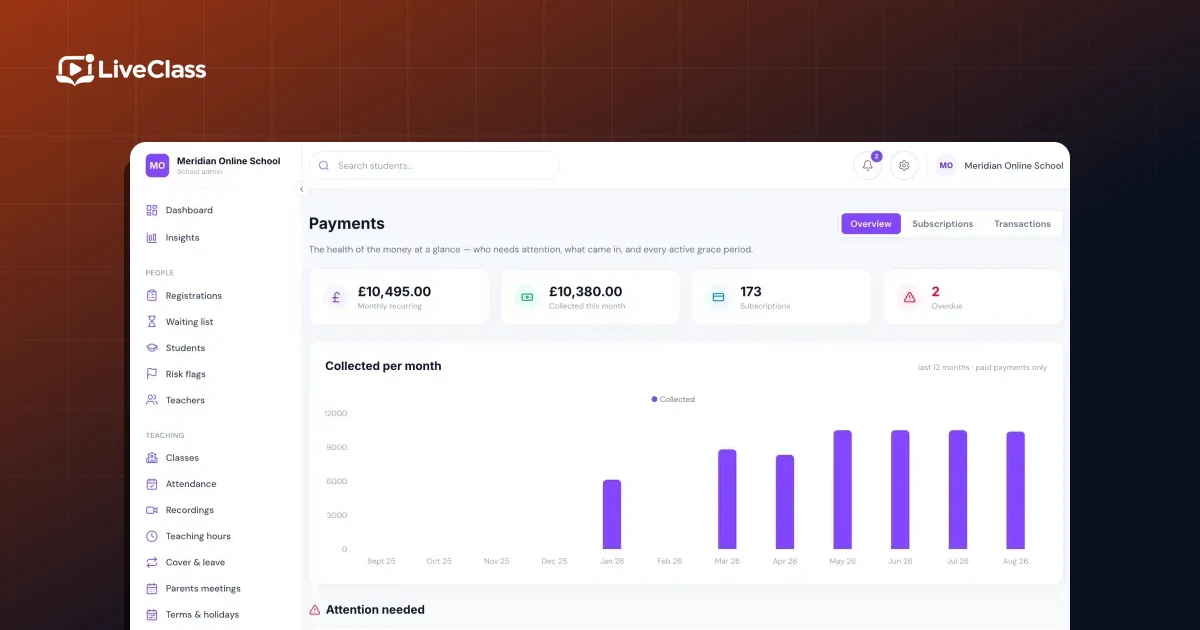
Whether access depends on payment. If it does, the system enforces it and nobody has a difficult conversation. If it does not, someone has to have that conversation every month, and in practice they stop having it. Both are legitimate choices; drifting between them is not.
Whether you chase on a schedule or on a feeling. A fixed ladder — a reminder before the due date, then at three days, seven days and fourteen days overdue, then stop — is kinder than sporadic chasing, because it is predictable and it is obviously not personal. It also ends. A school that chases forever teaches parents to ignore it.
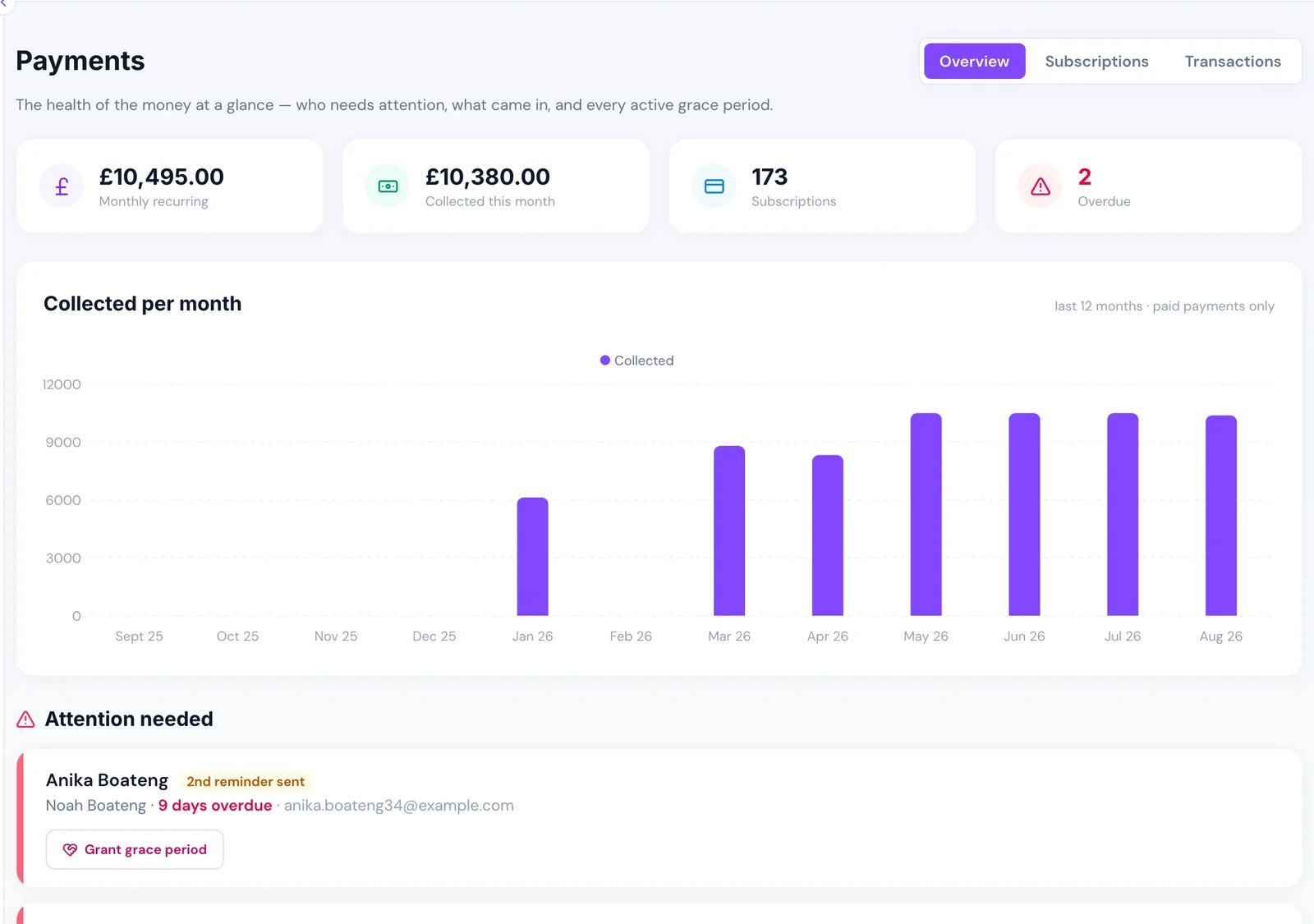
Not every school can take cards. Plenty of schools collect by bank transfer, and some operate in places where card payment is not the norm at all. That is a property of the school, not a lesser way of doing things, and any system you use has to treat it as normal rather than as a workaround. More on all of this in how online schools collect tuition fees.
3. Attendance: the register nobody has time to take
A teacher running a live lesson to twenty children cannot also reliably take a register. They will do it for the first month and then they will do it sometimes.
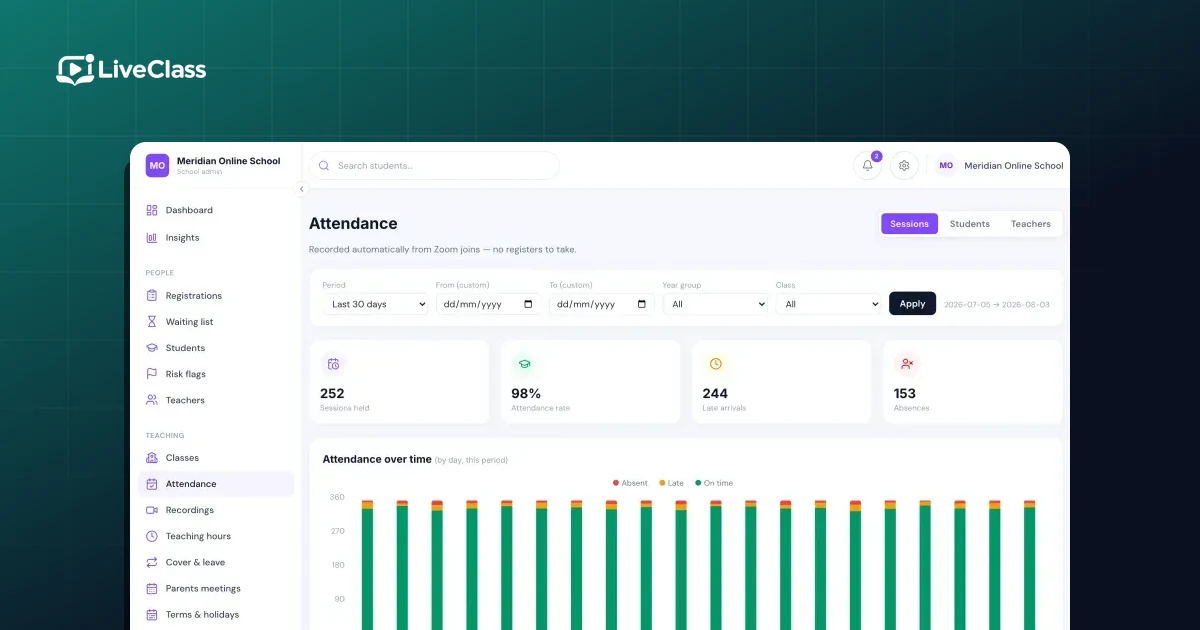
The good news is that a video platform already knows exactly who joined, when, and for how long — far more precisely than a human register ever did. The bad news is that turning that data into an attendance record has more edge cases than anyone expects: pupils who join on a phone under a nickname, pupils who drop out for ninety seconds because their wifi died, lessons that never happened at all.
That last one is worth stating plainly, because it is the trap: if your system marks pupils absent for a lesson that did not take place, you will build a beautiful attendance report full of fiction, and the first person to notice will be a parent. A session with no join events at all is far more likely to be a cancelled lesson than twenty simultaneous truants. We learned that the expensive way. The full version is in how to take attendance in a live online lesson.
4. Cover: twenty minutes to find a teacher
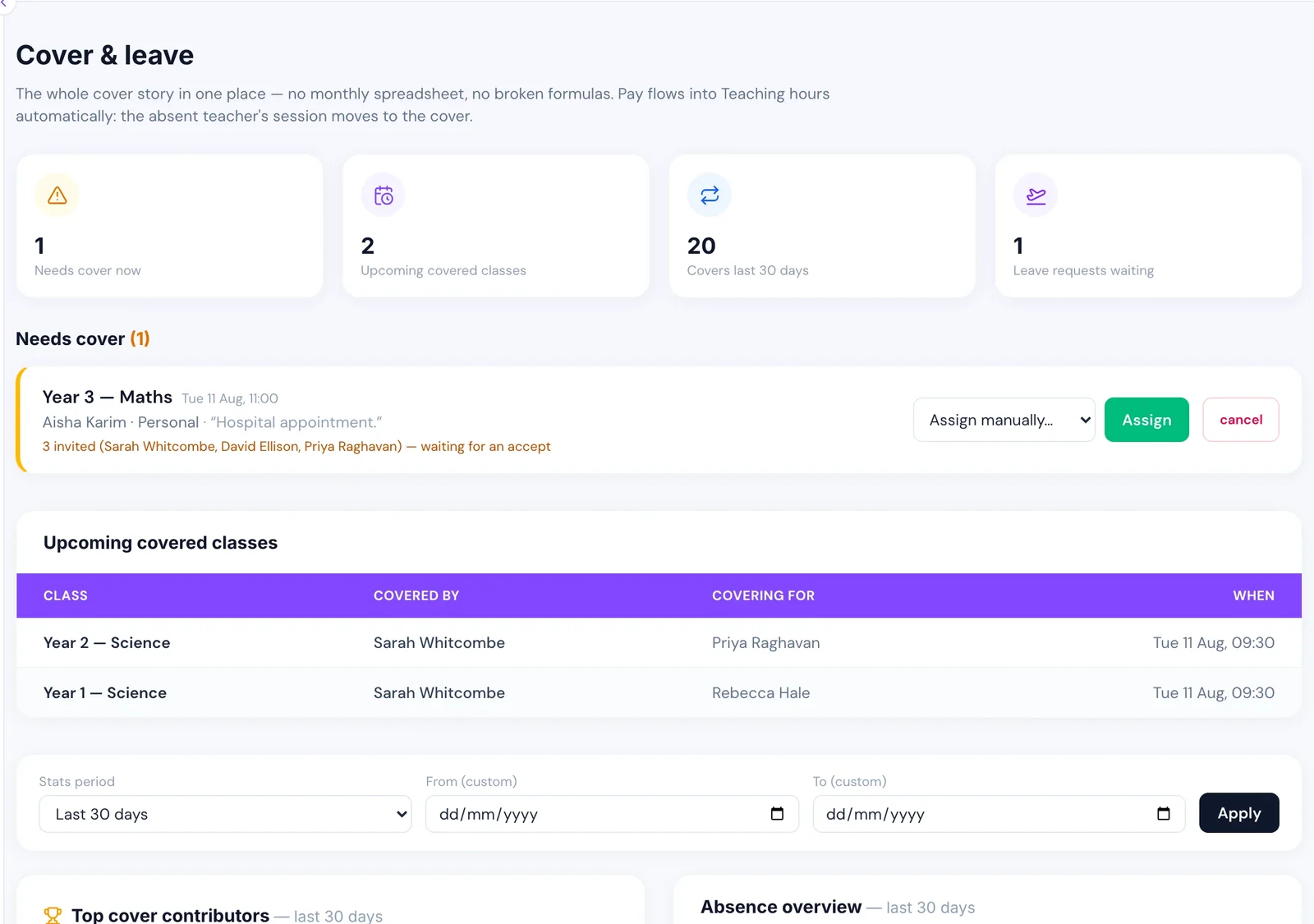
A teacher emails at 8:20 to say they are ill. The lesson is at 9:00. In a building, the head walks down the corridor. Online, the head needs to know — right now, without asking anyone — which teachers are free at 9:00 and which of them can teach Year 9 maths.
Most schools discover they cannot answer that question quickly, and the fallback is a WhatsApp group and hope. It works until the day it does not, and the day it does not, twenty families sit in an empty Zoom room. That is the single most visible failure an online school can have, because unlike a covered lesson in a building, there is no adult in the room to improvise.
Two things make it survivable: a timetable that can be queried by time and not just by class, and a decision made in advance about what happens when no cover exists — cancel and notify, or run it as supervised independent work. Deciding at 8:45 is deciding badly.
5. Reporting: proving learning happened
Parents paying for an online school ask a question that physical-school parents mostly do not: is this working? They cannot see the classroom, they cannot chat at the gate, and they are paying directly. The evidence has to be manufactured deliberately.
Termly report cards do most of that work, and they are harder online than on paper only because the marks live in more places. The thing worth getting right early is the arithmetic: decide now what happens when a pupil has no mark for a component. Dropping the component and renormalising the remaining weights is almost always the honest answer — scoring a missing component as zero punishes a child for a lesson the school cancelled.
6. The parent relationship, without the school gate
Everything above adds up to this one. In a building, a hundred small interactions maintain the parent relationship without anyone planning them. Online, if you do not deliberately create contact, the only messages a family ever gets from the school are fee reminders — and a school that only ever contacts you about money feels like a subscription, not a school.
The practical version: parents should be able to see attendance, homework and reports whenever they want without asking, and should hear something positive from the school before they hear something transactional.
What this looks like when it works
The pattern across schools that have got this right is not that they use one particular tool. It is that each of the six has exactly one home, and the homes are connected — attendance knows about the timetable, fees know about the pupil, reports know about the marks.
The failure pattern is the opposite and it is extremely common: enquiries in a shared inbox, fees in a spreadsheet, attendance in a second spreadsheet, marks in a third, parent contact in WhatsApp. Every one of those is individually reasonable. Together they mean nobody can answer "how is this child doing" without opening five files, and nobody notices a child drifting until they have already left.
If you are at the spreadsheet stage, the honest next step is not to buy something — it is to write down which of the six is costing you the most this term, and fix that one. Usually it is fees, occasionally it is attendance, and once in a while it is cover, on the morning it fails.
When you do start looking at software, be aware that most of the school management market was built for schools with buildings, and the assumptions that breaks are not obvious from a feature list.
Where to go next
- Do you need to register an online school with the DfE? — registration, accreditation, and which one is compulsory
- How to take attendance in a live online lesson — the mechanics, and the edge cases that produce wrong registers
- How online schools collect tuition fees — billing cycles, chasing, and access-linked payment
- Chasing unpaid school fees — a reminder ladder that ends
- Why school ERPs built for buildings fail online schools — five assumptions that break