Every leaked enquiry is a year's fees. That is the whole reason admissions deserves a process rather than a shared inbox, and it is why this is usually the most expensive thing a small online school is getting wrong without knowing it.
The failure is rarely dramatic. Enquiries arrive by email, a website form, WhatsApp and a message to somebody's personal Instagram. Two people reply to different ones. A third family is waiting on an answer nobody realises they promised. Nobody can say, this morning, how many people are mid-conversation with the school.
Every enquiry has exactly one state
The fix is not software. It is deciding that an enquiry is an object with a state, and that the state is always one of a small, fixed set:
- New — arrived, nobody has replied yet
- Contacted — a human has responded, waiting on the family
- Assessed — you know what year group and level they need
- Offered — a place is on the table, waiting on a decision
- Enrolled — accepted and paid
- Declined / lapsed — closed, with a reason
The value is not the list. It is that every enquiry is in exactly one of them, and that you can see how many are in each. A school that can answer "how many families are waiting on us right now?" stops leaking almost immediately, because leaks are what invisible states look like.
Two states earn their place specifically:
Assessed exists because online schools take pupils mid-year from a dozen different curricula, and "which year group" is genuinely a decision rather than a lookup. Skipping it means the question gets settled in week two by a teacher who inherits a mismatched child.
Declined needs a reason, because "we were too expensive" and "we could not offer the year group" are different problems and one of them is fixable.
Rolling admissions is the normal case, not the exception
Building-based systems assume an intake: applications in the spring, offers, a September start. Online schools mostly do not work that way. A family finds you in February and wants to start next week, because the reason they are looking is usually urgent — a move, a school that is not working, a child out of education.
That has two consequences worth designing for.
Fees have to be pro-rated from a mid-period start, or your first invoice to a new family is wrong, which is a bad first impression to buy for no reason.
The timetable has to absorb a pupil mid-term without anyone rebuilding it. If adding one child means editing several class lists by hand, admissions will quietly start batching new joiners, and batching is just a slower leak.
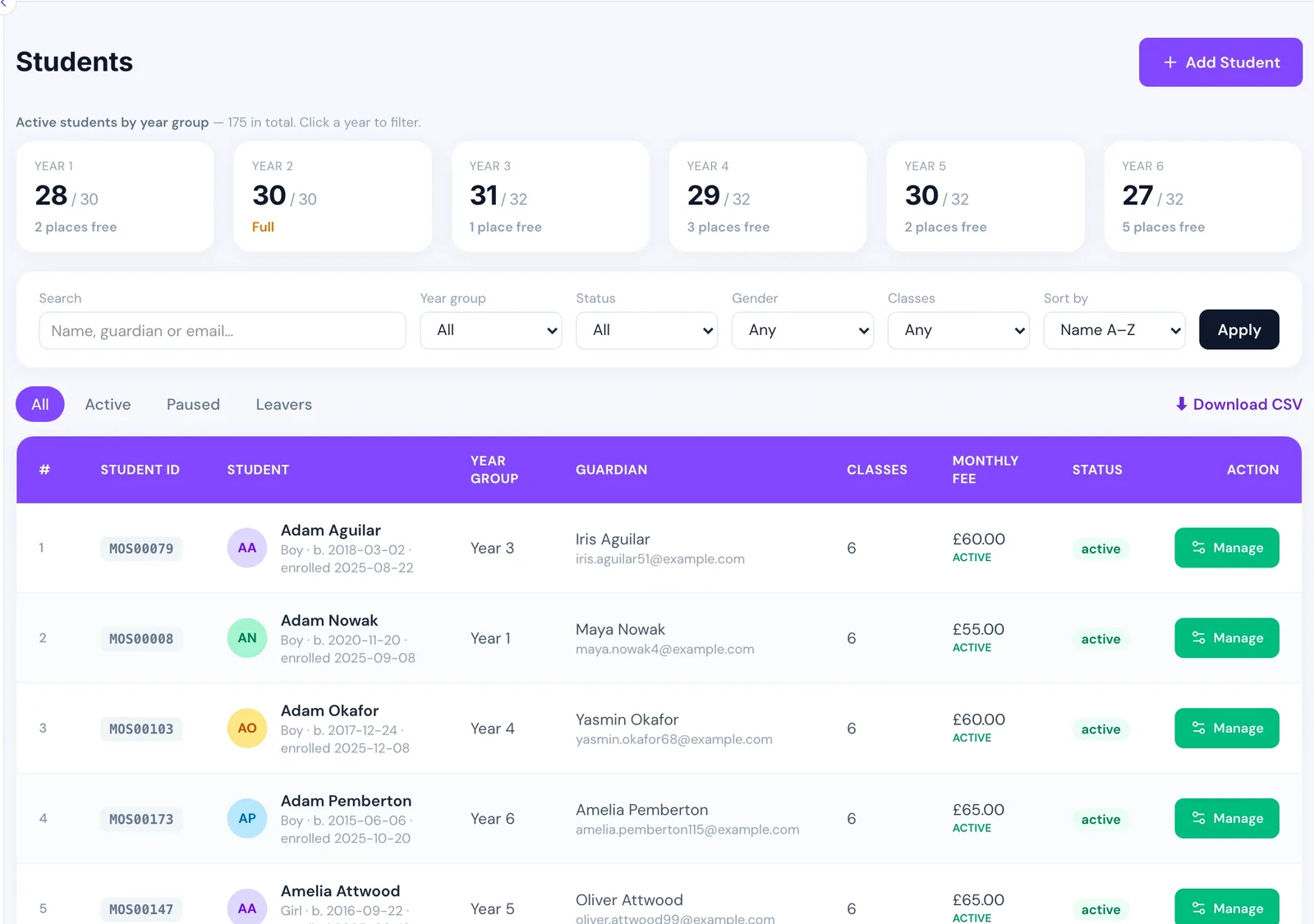
What to ask on the registration form
The form is where most schools either lose people or collect nothing useful. The rule that resolves it: ask only what changes what you do next. Everything else can wait until the family has accepted a place.
Genuinely needed to make an offer:
- child's name, date of birth and current year group
- what they are studying now, and in what language
- which country and time zone they are in — this decides whether you can teach them at all
- a parent's name, email and phone
- how they found you
Ask later, once they have accepted: previous school reports, medical and dietary detail, additional needs documentation, emergency contacts beyond the first, photo permissions.
A form asking for a passport scan and three referees before a family has spoken to a human converts terribly. A form asking six questions converts well and tells you enough to have the conversation.
One thing worth asking that most schools omit: what has to be true for this to work for you? The answers are specific and useful — a lesson time that fits a job, a particular exam board, a teacher who speaks the family's language.
The offer, and the week that follows
An offer should say four things without the family having to ask: which year group, which subjects, what it costs, and when the first lesson is. Vagueness at this point is read as disorganisation, and a parent handing over a child's education to people they have never met in person is already looking for reassurance.
Then the first week decides retention. A family who cannot get logged in, does not know when lessons are, and has not spoken to a teacher will be quietly gone by half term regardless of how good the teaching is. The handover that works is dull and specific: credentials that work before day one, a timetable in the parent's own time zone, a named person to ask, and one deliberate positive contact from the school in the first fortnight that is not about money.
When the year group is full
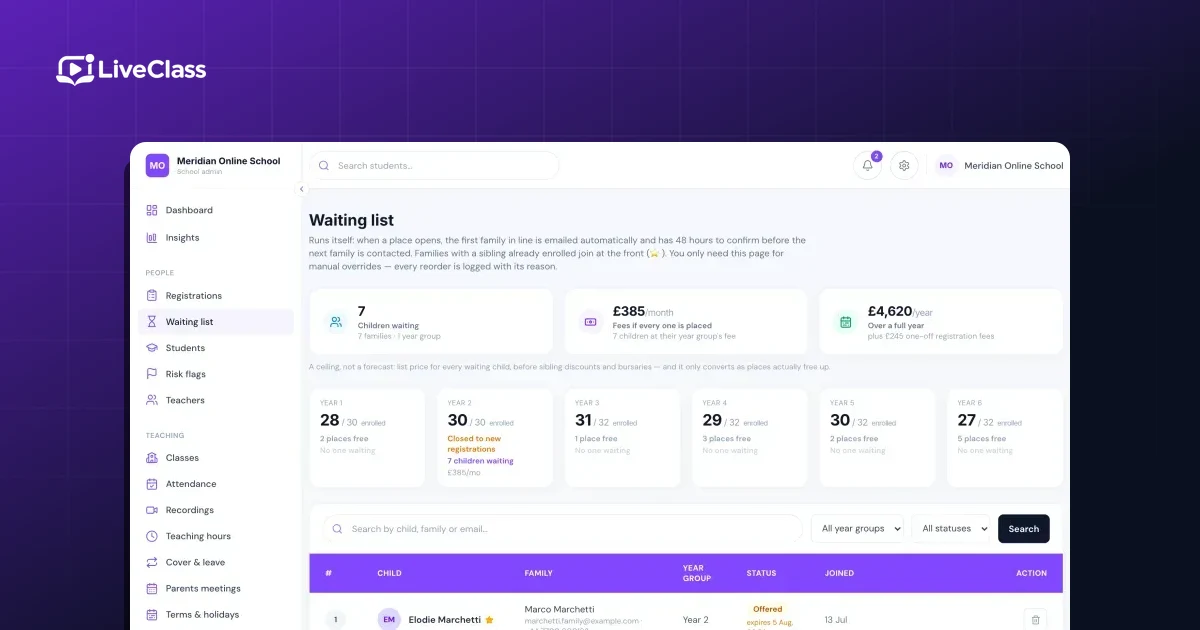
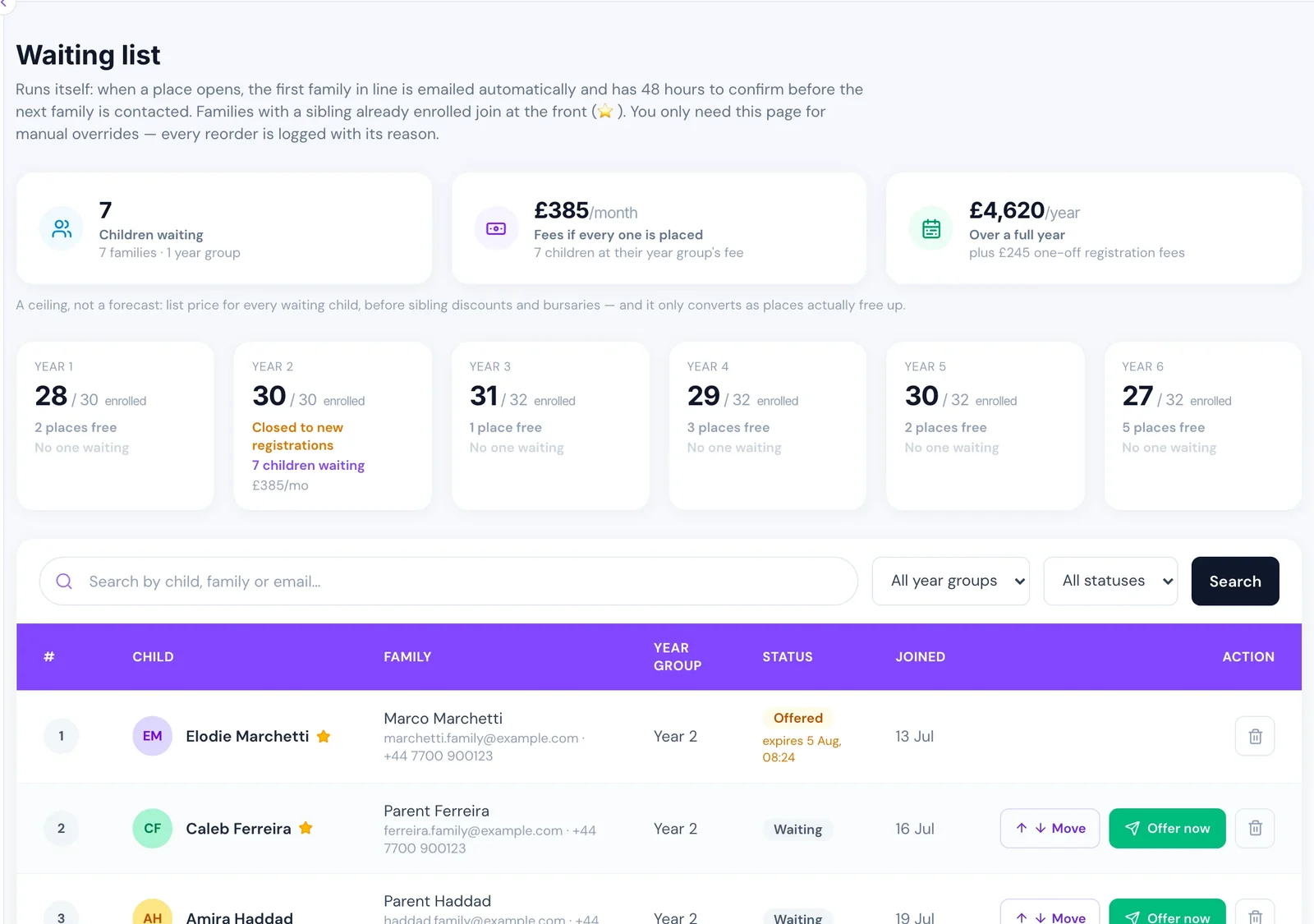
A full year group is not the end of the conversation. The family has already chosen you, which makes them the highest-converting prospect you will ever have — see running a waiting list for a full year group.
Where this sits
Admissions is one of six processes that have to work every week in a school with no building; the others are in the operations guide. It is the one where the cost of getting it wrong is easiest to calculate, and the hardest to see.