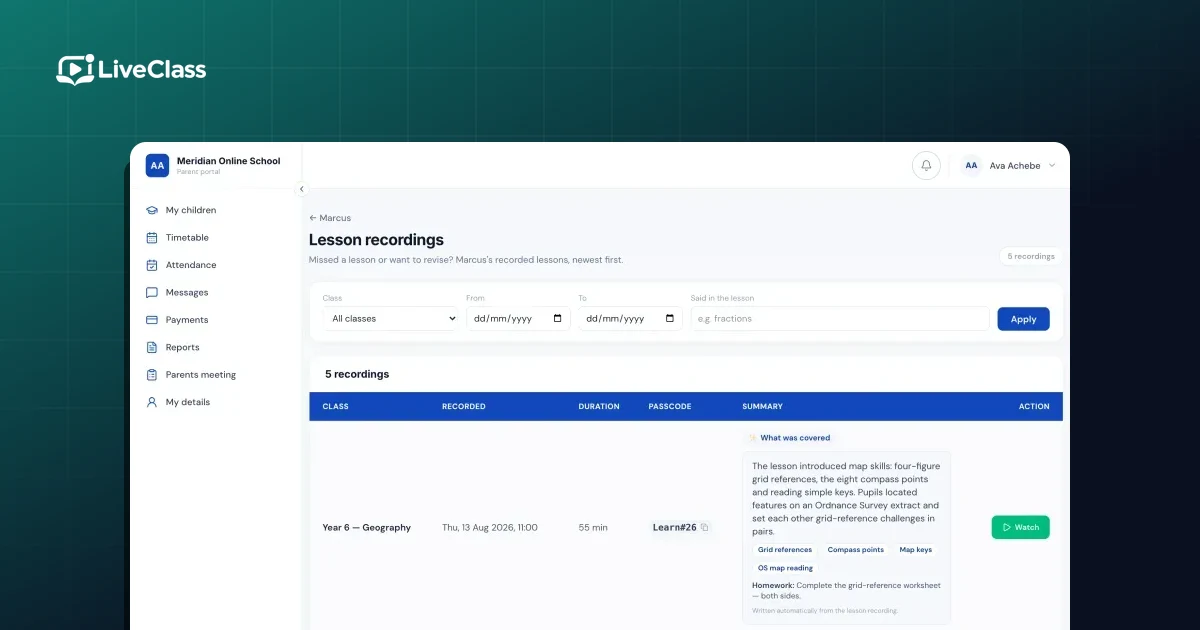
Recording lessons is one checkbox, which is why most online schools switch it on without a policy and end up holding thousands of videos of other people's children with no decision behind any of it.
The recordings are genuinely valuable. They are also the largest concentration of sensitive data most small online schools will ever hold. Both things are true, and the difference between them is a handful of decisions.
What recordings are actually good for
A pupil who missed the lesson. The obvious one, and the strongest. In an online school illness does not mean a missed morning, it means a missed lesson with no classmate to borrow notes from.
Revision. A recording of the lesson where a topic was first explained is more useful than any set of notes, particularly for pupils working in a second language.
Teacher development, where a teacher chooses to review their own lesson.
Evidence, occasionally. When a parent disputes what was said or a safeguarding question arises, a recording answers it definitively. This is real, but it is a by-product — a school that records primarily for this reason has a trust problem to fix instead.
The three questions that constitute the policy
Who can see it?
A recording of a class contains other children — their faces, their voices, their questions, sometimes their mistakes. "Anyone with the link" is not an acceptable answer for a school, and it is the default in more setups than people realise.
The version that works: visible to the pupils in that class and their teachers, and nobody else. Not the whole school. Not other year groups. Not a public folder.
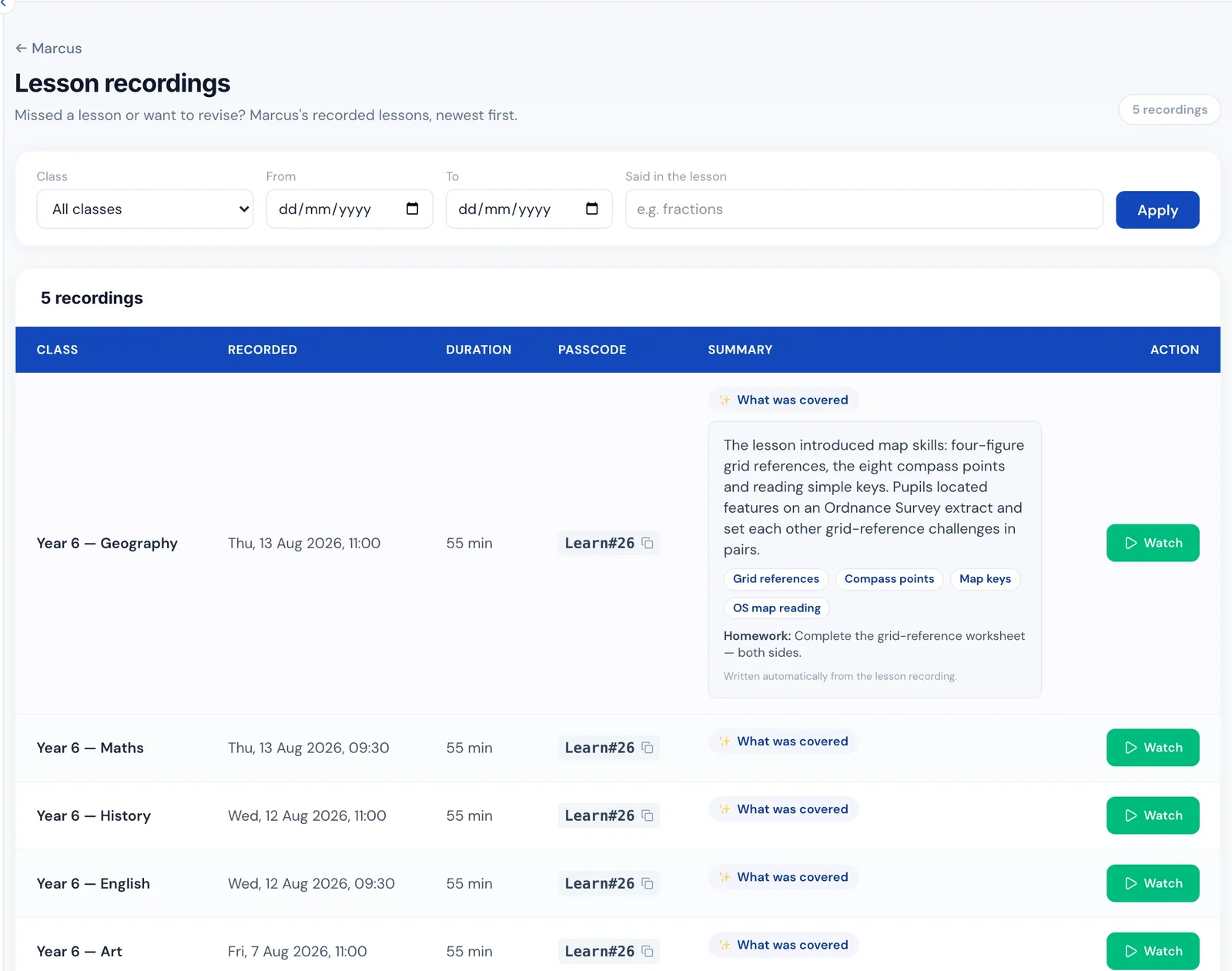
Parents wanting access is reasonable and awkward — a parent watching a recording is watching other people's children. Most schools resolve it by letting the parent view it with their own child, through the pupil's own account, rather than issuing separate parent access.
How long do you keep it?
Indefinitely is a decision, not an absence of one, and it is the one you will struggle to justify to a parent or a regulator.
Match retention to actual usefulness. A recording is heavily watched in the fortnight after the lesson, occasionally before an exam, and essentially never after that. A term, or an academic year, covers real use. Set the window once and let deletion happen automatically — a policy that depends on someone remembering to delete things is not a policy.
What is announced, and to whom?
Everyone in the room should know it is being recorded, every time, and it should not depend on the teacher remembering to say so. Families should be told at enrolment that lessons are recorded, what the recordings are for, who can see them and how long they are kept — in the enrolment terms, not buried in a policy PDF nobody opens.
The children who cannot be recorded
Every school of any size eventually has one. A child under a protection order, a child in a refuge, a family with a specific and legitimate reason.
Have an answer before you need it, because the day you need it you will need it immediately. Usually one of: the pupil attends with camera and microphone off and is not captured, the lesson is not recorded, or the recording is deleted immediately after that lesson.
What does not work is discovering the requirement after the recording exists.
One-to-one sessions are a different case
A one-to-one lesson between an adult and a child, online, with no third party present, is the situation every safeguarding framework treats most carefully.
Most schools land on: recorded by default with no teacher discretion to disable it, or a second adult present. Not neither. The recording here protects the teacher as much as the child, and experienced staff generally welcome it once that is said out loud.
The unglamorous risks
Storage cost compounds. A school recording every lesson pays a bill that grows every term and never falls, unless retention is automatic. This alone justifies the retention window.
Recordings leak through sharing, not hacking. Almost every incident is a link forwarded by a well-meaning person. Access tied to identity rather than to a link is the defence.
Nobody can find anything. A recording that cannot be located is pure cost and pure risk. Tie recordings to the lesson and class they came from rather than to a date-stamped filename in a folder.
The short version
Record, because it helps pupils who were ill and pupils revising. Restrict visibility to the class. Delete on a schedule you set once. Announce it automatically. Decide in advance what happens for the child who cannot be recorded, and never leave a one-to-one both unrecorded and unwitnessed.
The rest of the platform setup is in running live lessons on Zoom for a whole school.