Almost nobody leaves an online school suddenly. In hindsight it is nearly always visible for weeks: attendance slipping, homework stopping, camera off, a parent who used to reply and now does not.
The problem is not that the signals are subtle. It is that nobody was looking at the right thing, because the obvious thing to look at — an attendance percentage — is the metric most likely to miss the pupil you can still save.
Why a flat threshold misses the ones you can help
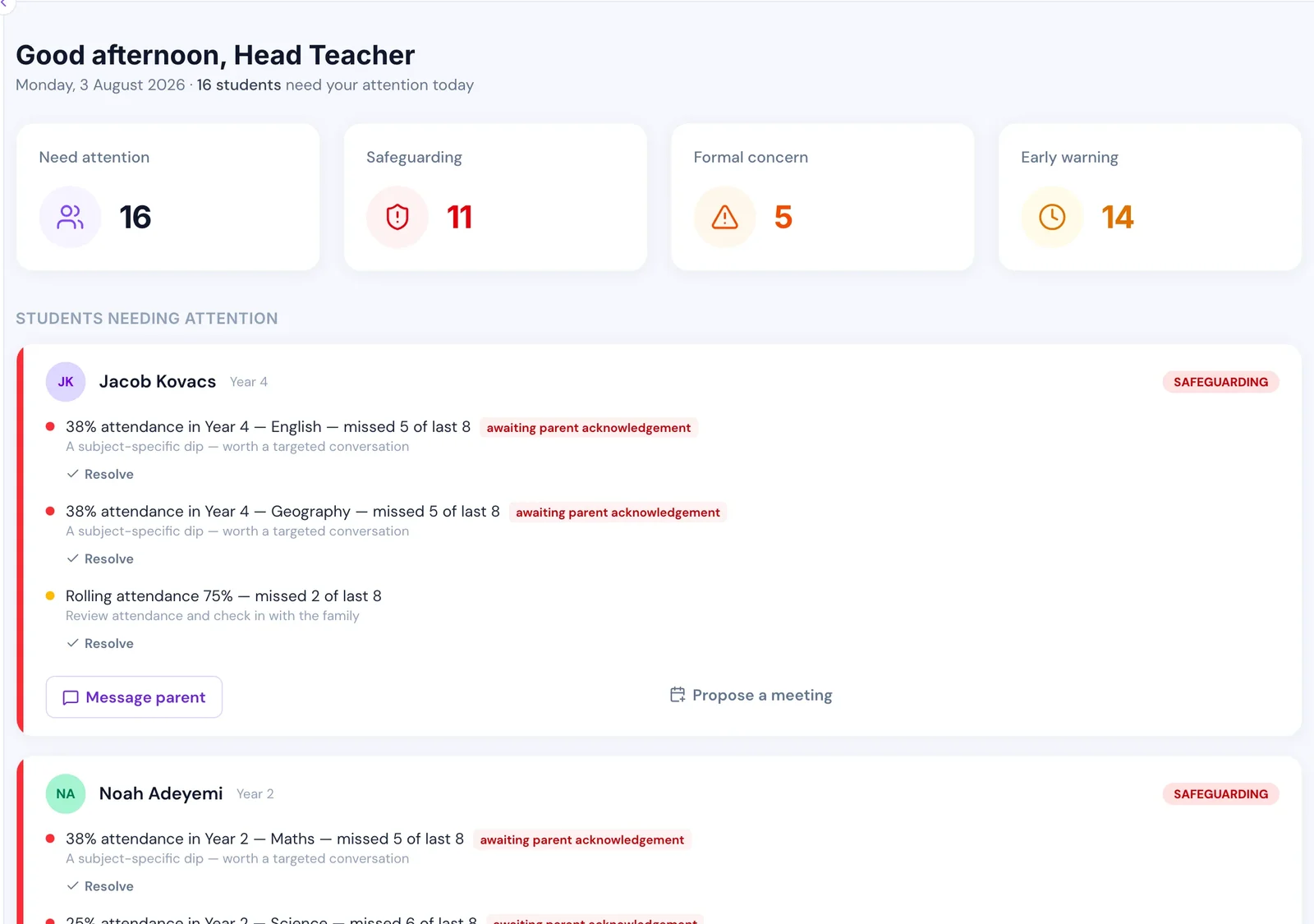
Set an alert at 85% attendance and you will get a list. It will mostly contain the same pupils every week: the ones who have always been at 70%, whose circumstances you already know about, and about whom the alert tells you nothing new.
Meanwhile the pupil who was at 100% for two terms and has just dropped to 88% does not appear at all. That child is the one whose situation has actually changed, and the one where an email this week might still make a difference.
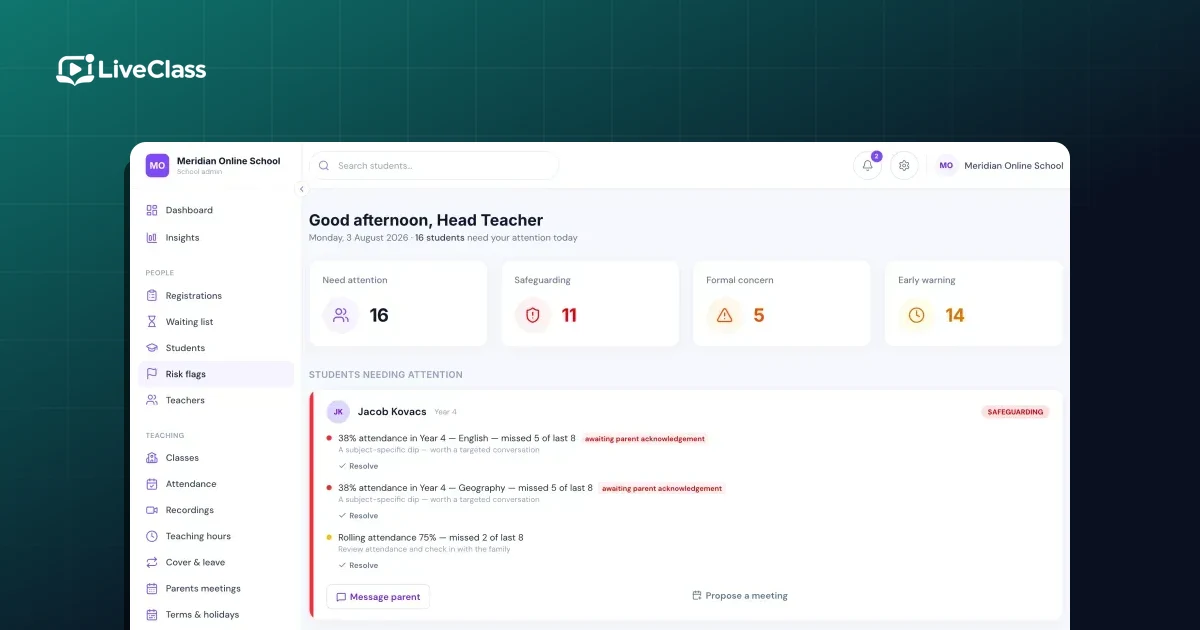
Measure each pupil against their own recent average, not against a school-wide line. A material fall relative to their own baseline is a far better signal than any absolute number, because it catches change rather than state.
The four signals worth watching together
No single one is reliable. Together they are.
Attendance falling against the pupil's own average. The earliest and most quantifiable.
Homework stopping. Often precedes attendance decline — a child who has fallen behind stops handing in before they stop turning up, because turning in nothing is more exposing than turning up quietly.
Camera going off permanently in a class where it was previously on. On its own it means very little; alongside the other two it is worth noticing.
A parent going quiet. The family that used to reply to messages within a day and now does not is disengaging as a unit, which is usually a bigger deal than the child having a bad fortnight.
The bit schools get wrong: the list has to be short
A risk report listing forty pupils is read once and never again. Nobody has forty conversations, so the report becomes decoration.
Ten is a working list. Five is better. Ruthless thresholds are not a compromise here — a short list that gets acted on beats a comprehensive one that does not, every single time.
Which also means the list needs a state: someone has looked at this child, this is what we did, review in two weeks. Without it the same names recur weekly, everyone stops reading, and you are back to a report nobody opens.
What the intervention actually is
Almost always: somebody who knows the child asks how they are, without mentioning attendance.
Not a letter about attendance requirements. Not a call from the office. A message from a teacher the child knows, or a call to the parent that begins by saying something true and positive. The information you need — a bereavement, a house move, a subject they have got lost in, a lesson time that stopped working when a parent changed jobs — only arrives in a conversation that is not an accusation.
A surprising share of drift in online schools turns out to be logistics rather than disengagement. A family whose 4pm lesson became impossible when a parent's shift changed does not usually tell the school; they just stop coming, and then they leave.
Where the data has to be honest first
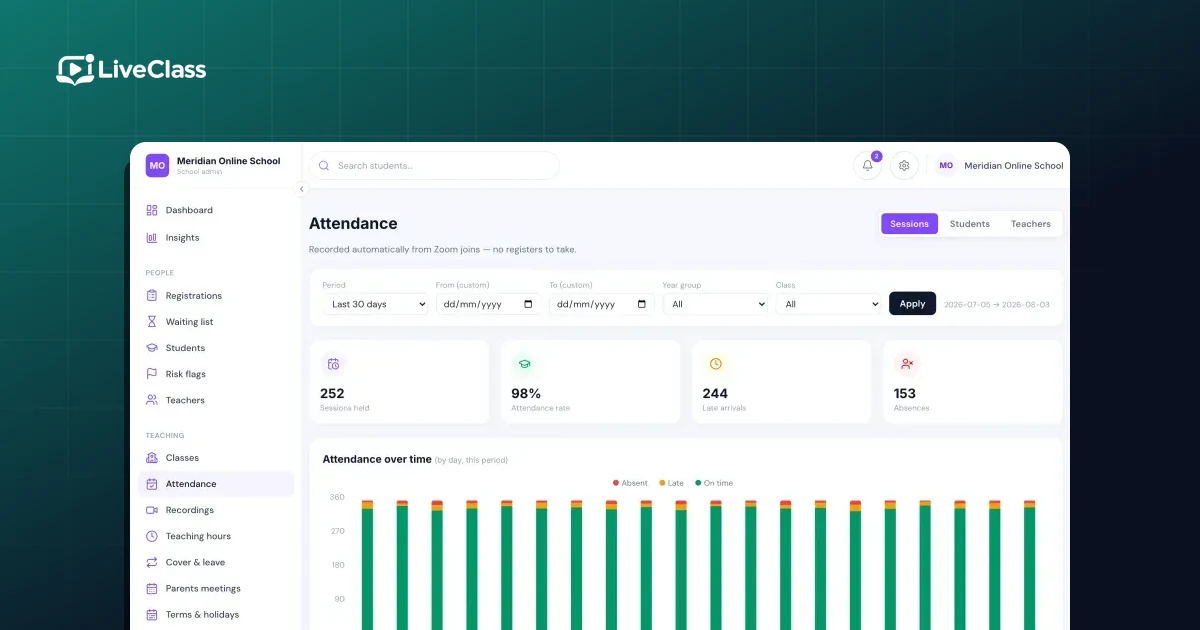
All of this depends on the attendance record being true. If your register marks a whole class absent for lessons that never ran, your risk list is full of fiction and staff will correctly learn to ignore it. That trap, and the rest of the mechanics, is in how to take attendance in a live online lesson.
Get the data right, measure each child against themselves, keep the list short enough to act on, and make the first contact a human one. That is most of it — and it is considerably cheaper than admissions.